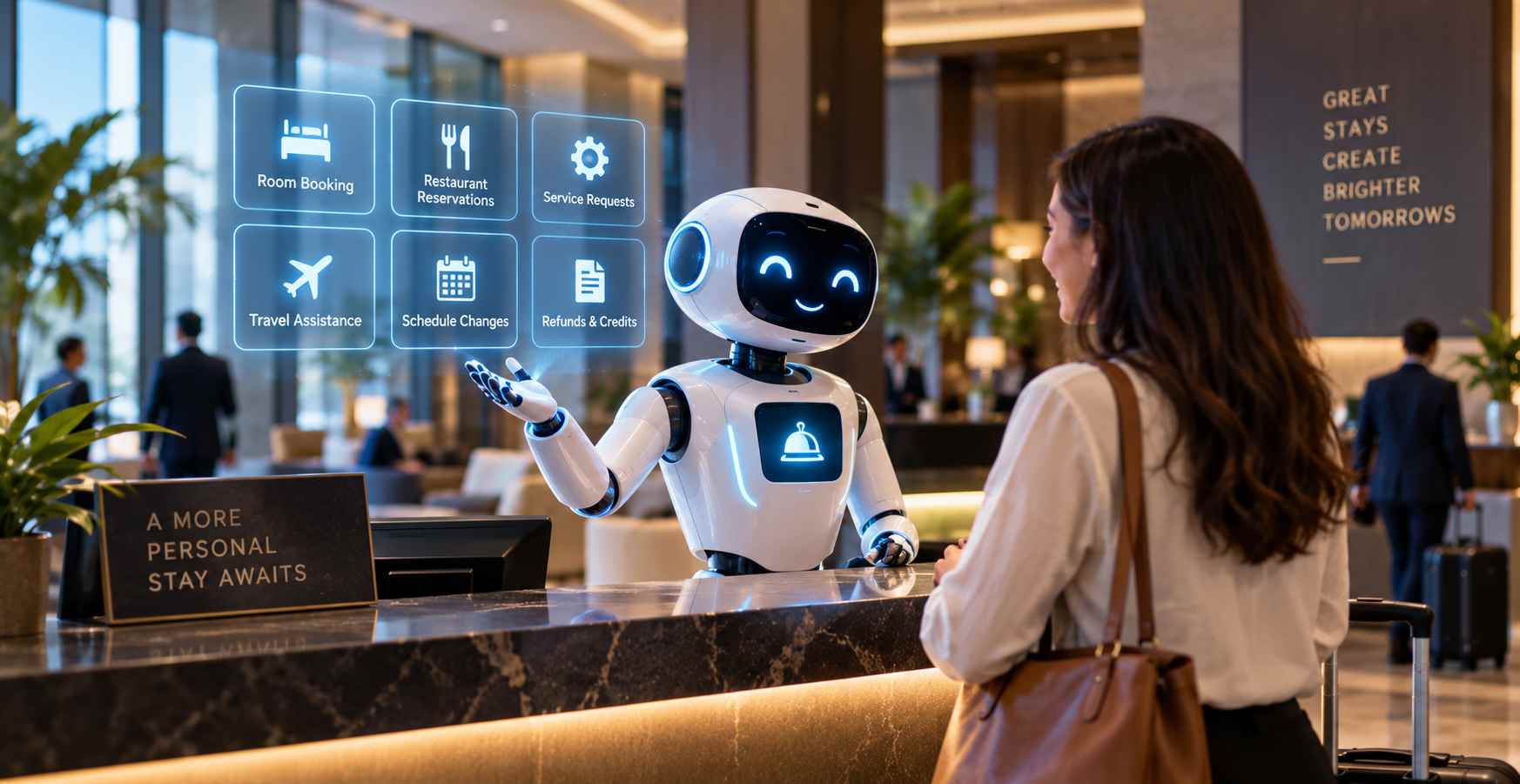
The industry has crossed a real threshold. AI systems now resolve 60-70% of routine guest inquiries without any human intervention - up from the 20-30% that older rule-based chatbots managed before hitting a dead end . The defining shift of 2026 is not more chat. It is the move from AI that talks to AI that acts - systems designed to execute multi-step tasks across systems rather than simply flagging an issue for a human to resolve . One scenario shows the whole difference.
A guest messages the hotel at 11pm asking to move their checkout from 11am to 2pm. A chatbot tells them the late-checkout policy. An AI agent checks room availability for that afternoon, confirms no conflicting booking, applies the late checkout to their reservation in the property management system, and sends a confirmation all without a front-desk agent touching the request. That is the entire difference between the two categories. It is also why most conversations about "AI in hospitality" are still describing 2023 technology while hotels are already buying 2026 technology.
The term AI agent gets used loosely in hospitality marketing. Operators often cannot tell whether they are buying a scripted FAQ bot with a new name, or a system that genuinely executes tasks inside their PMS. Getting the distinction wrong means one of two costly outcomes: overpaying for glorified chat widgets or underestimating the governance work required before an agent should ever touch a booking record.
This piece works through the actual technical tiers, what an agent can and cannot execute inside a real hospitality property, the systems backbone that determines whether any of this works at all, and the evaluation framework worth applying before signing a contract.
Chatbot vs Copilot vs Autonomous Agent - The Three-Tier Technical Distinction
Hospitality vendors rarely use this three-tier language. But the distinction underneath it is what actually determines cost, risk, and guest-experience outcomes. The table below is the quickest way to place any product a vendor puts in front of you.
| Dimension | Chatbot (Tier 1) | Copilot (Tier 2) | Autonomous Agent (Tier 3) |
|---|---|---|---|
| Core Role | Retrieves information, answers questions | Suggests and drafts responses | Executes multi-step tasks end to end |
| System Access | Read-only knowledge base / scripts | Reads live data, drafts into systems | Read + write across PMS, CRM, booking engine |
| Human Needed? | Yes - for anything beyond an answer | Yes - human reviews and clicks submit | No - acts within defined authority, logs an audit trail |
| Guest Experience | "Here's the policy" | Faster human response | "Done - your checkout is moved" |
| Primary ROI | Deflection of simple questions | Reduced agent handling time | Replaced labour hours on repetitive execution |
| Main Risk | Frustrates guests expecting resolution | Human remains bottleneck | Poorly governed authority at machine speed |
Tier 1 - Chatbot: Retrieves Information, Cannot Execute Actions
A chatbot is reactive by design. It matches an incoming query to a script or knowledge-base entry and returns an answer. It can tell a guest what time the pool closes, what the parking rate is, or whether breakfast is included. What it cannot do is change anything in a hotel system. If the guest wants that pool hour extended for a private event, or breakfast added to a room that currently excludes it, the chatbot hands the request to a human - usually by generating a ticket or a transfer. Its entire value proposition is deflection of simple questions, not resolution of guest needs.
Tier 2 - Copilot: Suggests and Drafts, Human Still Executes -H3
A copilot sits one layer deeper. It can draft a response to a guest complaint, suggest a compensation amount based on the incident type, or pre-fill a maintenance ticket with the right department and priority. But a human still has to review and click submit. This tier is common in contact-centre deployments, where agents get real-time suggestions surfaced during a live chat or call. The copilot reduces cognitive load and speeds up the human's decision - but the human remains the point of execution and the point of accountability.
Tier 3 - Autonomous Agent: Executes Multi-Step Tasks Within Defined Authority
This is where hospitality is actually heading in 2026, and where most of the genuine ROI sits. An autonomous agent reads live data from the PMS, CRM, and booking engine, reasons about what it finds against a defined ruleset, and takes the action itself. It works within defined limits across voice, chat, WhatsApp, and email simultaneously, without switching context. It creates the booking modification, dispatches the housekeeping ticket, issues the loyalty credit, and logs the entire chain of reasoning in an audit trail. No human clicks submit. The agent's authority is bounded by policy, not by its own judgment about what feels reasonable - which is the governance point every operator needs to understand before deployment, covered in detail later.
Why the Distinction Matters for Cost, Risk, and Guest Experience
Cost: a Tier 3 agent replaces actual labour hours on repetitive execution work. It does not just deflect simple questions the way a Tier 1 chatbot does. Risk: an agent with poorly governed execution authority can issue comps, waive charges, or modify rates at a scale a single rogue employee never could - simply because it operates at machine speed across every guest interaction at once. Guest experience: the guest asking to move their checkout does not want a script. They want the checkout moved. A Tier 1 deployment marketed as an AI agent will frustrate a guest expecting Tier 3 execution.
What an AI Agent Can Actually Execute in a Hospitality Property
The genuinely useful test for any vendor conversation is simple. Ask exactly which actions the agent can complete without human intervention, inside which systems, and under what constraints. Modern hospitality AI agents already handle guest communication, dynamic pricing, predictive maintenance, booking automation, and workforce scheduling. The most advanced operators run interconnected agent networks across the full guest journey .
Booking Actions - Modifications, Cancellations, Upgrades Within Policy
Date changes, room-type changes, and upgrade requests that fall within existing rate rules are the highest-volume category and the one with the fastest, clearest ROI. An agent that checks real-time inventory before confirming a change avoids the classic failure mode of confirming something the PMS cannot actually fulfil - which is exactly why integration depth matters more than model sophistication.
Before/After - Booking: A guest messages at 11pm to extend checkout to 2pm. The agent checks the PMS → confirms no conflicting arrival for that room → applies the late checkout → sends confirmation. Time: ~40 seconds. Previously: the guest waits until the front desk reopens the next morning, and may not get the slot at all.
Service Recovery Actions - Comp Credits, Late Checkout, Amenity Waivers
When a guest reports a service failure, a governed agent can issue a resolution immediately rather than waiting for a manager to become available. This is where the compensation-authority rails discussed later become essential, because an agent issuing comps without a ceiling tied to guest tier and incident type is a direct financial exposure.
Before/After - Service Recovery: A guest reports the room AC was down all night. The agent verifies the logged maintenance incident → applies a breakfast credit within the tier-and-incident ceiling → confirms it on the folio instantly. Time: under a minute. Previously: the guest is told a duty manager will "look into it," and follows up twice before anything happens.
Operational Actions - Housekeeping Dispatch, Maintenance Tickets, F&B Orders
Not every agent action faces the guest directly. A significant share of the value comes from back-of-house execution. An agent reads a guest's "AC not working" message, creates the maintenance ticket with the room number and urgency flag, and confirms an estimated resolution time - all inside the same interaction that would otherwise have required a front-desk staff member to manually relay the request to engineering .
Before/After - Operational: A guest messages "AC not working, room 412." The agent creates the maintenance ticket, tags urgency, routes it to engineering, and tells the guest a technician is on the way with an ETA. Time: ~30 seconds. Previously: the front desk takes the message, walks it to engineering between check-ins, and the guest hears nothing back.
Loyalty Actions - Points Adjustments, Certificate Issue, Status Match Requests
Loyalty servicing is repetitive, rules-based, and high in volume for chains with mature programmes. That makes it one of the cleanest categories for full agent autonomy - provided the loyalty platform is properly unified with the PMS and CRM, which is not universally true even among large chains still running legacy loyalty stacks.
Before/After - Loyalty: A guest asks why points from last week's stay haven't posted. The agent checks the folio → confirms the stay is eligible → posts the points → replies with the updated balance. Time: under a minute. Previously: a ticket goes to the loyalty team and the guest waits several days for a reply.
Where the Agent Must Stop and Escalate
Some situations must escalate to a human immediately, with full context attached: bereavement situations, safety incidents, legal threats, high-value complaints above a defined dollar threshold, and any request outside the agent's authority matrix. The design of that handoff - not the sophistication of the agent's language model - is what determines whether escalation feels like getting rescued or getting bounced.
The Systems Backbone That Determines Whether an Agent Actually Works
An agent is only as capable as the data and systems it can actually reach. This is the least glamorous part of any hospitality AI conversation, and the part that decides success or failure more than any other single factor.
PMS Integration Depth (Opera, Cloudbeds, Mews, Protel)
The property management system is the source of truth for availability, rates, and reservation status. An agent with shallow, read-only PMS access can answer questions but cannot execute anything meaningful. Genuine execution requires write access with proper API permissions - tested against the specific PMS version the property runs. A generic integration built against the vendor's newest cloud release is not the same as one tested against a property still on an older on-premises version.
CRS, CRM, and Loyalty Platform Data Unification
A guest's stay history, preferences, and loyalty status often live in systems separate from the PMS. An agent that cannot see across all of these produces the exact fragmented, repetitive experience that hospitality AI is supposed to eliminate - the one where a guest restates their loyalty tier or preference every time they touch a different channel.
Real-Time Inventory, Rate, and Room-Status APIs
Booking actions depend on real-time inventory and rate data, not cached feeds. A stale feed causes an agent to confirm a change the PMS later rejects. That is worse for guest trust than a chatbot that never promised execution in the first place.
Authentication and Guest Identity Resolution Across Channels
A guest messaging on WhatsApp, calling the front desk, and emailing about the same reservation needs to be recognised as the same person across all three - with the same permissions and history attached. Identity-resolution failures are one of the most common reasons agent deployments feel disjointed to guests, even when the underlying AI model is genuinely capable.
Governance Rails - the Layer Most Deployments Skip
This is the section most vendor pitches gloss over, and the one operator most regret skipping once an agent has been live for a few months. The table summarises the four rails; the detail follows.
| Authority Type | What It Controls | Example Ceiling | Risk If Missing |
|---|---|---|---|
| Rate Authority | Which rate codes the agent can apply, whether it can discount unprompted or match a competitor rate | Published rate codes only; no unprompted discounting | Rate integrity erodes invisibly across thousands of small interactions |
| Compensation Authority | Comp value the agent can issue, tied to guest tier and incident severity | e.g. up to one night's F&B credit for mid-tier; manager sign-off above | Well-meaning agent consistently over-comps with no financial ceiling |
| Refund Authority | Timing, method, and exception handling for refunds | Standard cancellation window only; exceptions escalate | Non-refundable bookings, active chargebacks, and edge cases get mishandled |
| Audit & Explainability | A logged, reviewable trail for every autonomous action | 100% of actions logged with data read + rule applied | No way to diagnose a governance gap before it becomes a pattern |
| Primary ROI | Deflection of simple questions | Reduced agent handling time | Replaced labour hours on repetitive execution |
| Main Risk | Frustrates guests expecting resolution | Human bottleneck remains | Poorly governed authority at machine speed |
Rate Authority - What the Agent Can Quote and Modify
An agent needs an explicit boundary on which rate codes it can apply, whether it can offer a discount unprompted, and whether it can match a competitor rate a guest mention. Without this defined in writing before launch, rate integrity erodes gradually and invisibly across thousands of small interactions.
Compensation Authority - Comp Ceilings by Guest Tier and Incident Type
A reasonable governance model ties comp value to both the guest's loyalty tier and the severity of the incident, with anything above a set ceiling requiring human sign-off. Without this, a well-intentioned agent trained to prioritise guest satisfaction will consistently over-comp. "Make the guest happy" without a financial ceiling is not a rule - it is an invitation to overspend.
Refund Authority - Timing, Method, and Exception Handling
Refund policy needs the same explicit treatment as compensation. That is especially true around exception cases: non-refundable rate bookings, chargebacks already in process, or refunds requested outside the standard cancellation window.
Audit Trails and Explainability for Every Autonomous Action
Every action an agent takes needs a logged, reviewable trail explaining what data it read, what rule it applied, and why. This is not optional for compliance. It is also the single fastest way to diagnose a governance gap before it becomes a pattern of repeated errors.
Where AI Agents Outperform Human Front-Desk (And Where They Do Not)
Outperform: Volume Handling, Multilingual Coverage, Consistency, After-Hours Response
Agents do not get tired at 3am, do not have a bad day that shows up in tone, and can respond in over a hundred languages without hiring native speakers for every market a property serves. For high-volume, rules-based interactions, this is a genuine and durable advantage.
Do Not Outperform: Emotional Situations, Bereavement, High-Value Complaints, Complex Multi-Property Loyalty
A guest dealing with a genuine emergency, a significant loss, or a complaint that requires weighing competing considerations - brand reputation, guest history, unusual circumstances - still needs a human. Hospitality that tries to automate empathy at this level consistently produces worse outcomes than a well-trained human, regardless of how sophisticated the underlying model is.
The Handoff Design That Determines Guest Experience
The quality of the escalation, not the sophistication of the AI, is what a guest remembers about a difficult interaction. An agent that recognises its limits quickly and hands off with full context intact produces a materially better outcome than one that keeps attempting resolution past the point where a human should have taken over.
Deployment Failure Modes We See Repeatedly in Hospitality
Rolling Out Without Front-Desk Change Management
Front-desk and reservations staff who were not consulted before an agent went live tend to see it as a threat rather than a tool. That shows up in subtle sabotage - staff routing guests around the agent, or simply failing to reinforce its use - which undermines adoption regardless of how well the technology performs.
Weak PMS Integration Producing Wrong Availability Data
Covered above from the systems side, but worth repeating as a failure mode in its own right. It is consistently the single most common technical cause of a guest-facing AI agent producing an outright wrong answer.
No Governance Rails on Discretionary Comps and Upgrades
Financial exposure accumulates quietly here, one small over-comp at a time. It usually surfaces in a quarterly review as a pattern that should have been caught in week one with a properly configured ceiling.
Treating the Rollout as an IT Project, Not a Guest Experience Project
Properties that hand the deployment entirely to IT - without involving the guest-experience or operations team - consistently under-invest in the tone, escalation design, and brand-voice work that determines whether guests actually like interacting with the agent.
Skipping Multilingual Testing on Non-English Guest Segments
An agent tested only in English will frequently perform noticeably worse in other languages, particularly on nuanced requests. Properties with a meaningfully international guest mix cannot treat this as a minor detail.
The Evaluation Framework Before Signing an AI Agent Contract
Bring this table straight into the vendor meeting. Each row is something to confirm on the record before signature - not after the agent is already live.
| Evaluation Item | What to Confirm | Red Flag If Missing |
|---|---|---|
| 1. Integration Inventory | Vendor has tested - not just claimed - integration against your specific PMS, CRS, CRM, loyalty, and payment versions | "We support Opera" with no reference to your version or deployment type |
| 2. Authority Matrix | A written document defining what actions, at what value ceilings, for which guest segments | Authority "to be worked out after go-live" |
| 3. Multilingual Coverage | Tested performance against your top five guest-origin languages specifically | A generic "100+ languages" claim with no nuanced-request testing |
| 4. Escalation Path Design | Real escalation scenarios run pre-launch, with complete context transfer to the human | Handoff demoed only in the happy path, context transfer untested |
| 5. Explainability & Audit | Audit-trail format meets your regulatory or internal compliance standard | No per-action logging of data read and rule applied |
| 6. Change Management Plan | Staff communication and training built into the deployment timeline itself | Front-desk training treated as an afterthought post-launch |
How to Measure Whether an AI Agent Is Actually Working
Autonomous Resolution Rate (Not Deflection Rate)
Deflection measures how many interactions avoided a human. Resolution measures how many were actually solved. An agent can post a high deflection rate and a low-resolution rate at the same time - and that gap is where guest dissatisfaction quietly accumulates.
Escalation Quality - What the Agent Correctly Hands Off
Track not just how often the agent escalates, but whether it escalated at the right moment with the right context. Watch both directions: escalating too early on things it should have resolved, and too late on things it should never have attempted.
Guest Sentiment on Agent-Handled vs Human-Handled Interactions
Compare satisfaction scores directly between the two categories, segmented by interaction type. This identifies specifically where the agent underperforms, rather than relying on an aggregate score that hides the gap.
Cost Per Resolved Interaction and Recontact Rate
The real cost comparison is not agent cost versus human labour cost per interaction. It is cost per interaction that did not require a second contact to actually resolve.
Where 1Point1 Fits in an AI Agent Deployment
Most hospitality brands do not have in-house teams built to manage PMS integration testing, multilingual QA, governance-rail design, and ongoing front-desk change management simultaneously - while also running the property. That is exactly the gap 1Point1 fills.
1Point1 works across the hospitality spectrum - hotels, resorts, multi-property chains, and OTAs - combining operational delivery with its own agentic AI platform, ResolX. ResolX's agentic layer, Omvia, is built to manage end-to-end interactions across voice, chat, WhatsApp, and email in a single unified flow - which is precisely the Tier 3 execution model this article describes. Our role in an agent deployment covers the workstreams brands most often under-resource:
- PMS integration experience across the major platforms - Opera, Cloudbeds, Mews, and Protel - with the write-access and version-specific testing that separates a real execution agent from a read-only chatbot.
- Multilingual coverage drawn from 1Point1's multi-shore delivery footprint across India, the UAE, Singapore, the UK, the US, and Latin America - so non-English guest segments are tested and staffed, not treated as an afterthought.
- Governance-rail design - authority matrices, comp and refund ceilings by guest tier and incident type, and audit-trail standards defined before launch.
- Front-desk change management and human escalation - keeping trained human agents staffed for the bereavement, safety, and high-value interactions that should never reach an agent in the first place.
Across these engagements, hospitality operators typically target [autonomous resolution rate], [recontact rate], and [guest-sentiment parity between agent- and human-handled interactions] - replace these bracketed placeholders with actual anonymised metrics from your own deployments before publishing.
The pattern recognition from doing this integration work across multiple PMS platforms and property types is what turns a six-month deployment struggle into a properly sequenced rollout.
Conclusion
The hospitality operators getting genuine value from AI in 2026 are not the ones with the most sophisticated language model. They are the ones who built the integration depth, the governance rails, and the escalation design before asking the agent to touch a single guest interaction. Getting the chatbot-versus-agent distinction right at the start of the vendor conversation saves months of rework later. It is the difference between guests feeling genuinely served and guests feeling like they are talking to a slightly better search bar.
If you are evaluating an AI agent deployment for your property or chain, 1Point1 brings hospitality-specific PMS integration experience, multilingual coverage, and governance design - backed by its ResolX agentic platform - to make sure the agent you deploy actually executes, not just responds.